Tuesday, August 29, 2006

Kol Yisrael Arevim

In today’s Haaretz I was pleased to read a poll that reported one out of every two households in central and southern Israel gave money or goods to residents of the North during the war.
The poll, conducted by Dr. Haggai Katz of the Israel Center for Third Sector Research at Ben-Gurion University of the Negev, also found that one out of four households had hosted residents from the North, primarily relatives or friends. Five percent of the households hosted strangers.

The survey also found that contributions and volunteering by the Orthodox were only slightly higher than among the secular; during peace time, the gap between the two groups is much greater.

I know on this blog I tend to sometimes focus on the flaws of Israel, but reading news like this makes me feel so proud of our little country, her citizens, and the way they behave to each other. A real or lagoyim.

May this Ellul be one filled with teshuva and accounting of our actions.

(Picture - A family in the North removed strategic roof tiles so that the light from their attic spells out "BiHatzalacha" (Good Luck) -- its clearly visible to all IAF planes and helicopters flying into Lebanon from Israel –from the muqata)

Tuesday, August 15, 2006

There is no military solution

Last week Former MK Naomi Chazan and Arnold Roth, whose daughter was murdered in the Sbarro bombing were interviewed on Late Night Live hosted by Philip Adams. They had divergent opinions about the current war against Lebanon, but both treated each other with respect. They repeated the views of the other before they spoke, they addressed each other with their proper titles and they didn’t raise their voices.

A dialogue of this manner and maturity is what I was thirsting for, but thoroughly lacked during a number of experiences I had this weekend.

Professor Naomi Chazan repeated several times during the interview, as if it were a mantra handed down by a yogi master, “there is no military solution to this conflict.” It sounded so simple.

Discussing the conflict with my colleagues in Zionist education last Sunday, I felt that opining anything other than a military solution to Israel’s woes was heresy. One said: “It is wrong when Lebanese civilians die, but I don’t feel sad for them.” Another said: “There are no ‘two sides’ to this conflict. There is only one side. Ours! This is a war for our survival, for our right to exist” It could have been Anilewicz speaking in the Warsaw Ghetto. It wasn’t. I was in Melbourne.

Gideon Levy wrote in Haaretz today that our favorite phrase "an existential war" is nothing more than a ridiculous slogan, as it was actually a “war of choice” from the beginning.

Another of my acquaintances said that those who feel guilty for what Israel is doing in Lebanon are not real Jews. They have no pride in their tradition.

Moving on to Monday night, I went to hear Labour-Meimad MK Rabbi Michael Melchior speak at the house of Mark Baker, the President of my Kehilla, Shira Hadasha. He said about Qana “if you see crushed children and it doesn’t move you, something is blocked in your heart.” Hearing Rabbi Melchior, I was reminded of the midrash in Talmud Sanhedrin 39 about the angels who wanted to sing to Hashem as the Egyptians were drowning in the sea. God says to them, "My creations are drowning and you are singing before me?'"

Rabbi Melchior is often invited to speak on panels in Israel where he is thoroughly outnumbered by those who disagree with him. They say that the Geula (redemption) depends on how much land can be accumulated. He asks them to show where this is written in the shulchan aruch. They can’t. I think that the ideology of those religiously opposed to ceding land is much more potent than Torah.

On one page of the Talmud, there is a debate about when the world was created. The debate is not regarding the year in which the world was created, although this sparks great debate in the secular world. Instead, the debate focuses on which DAY the world was created. Two dates are offered. The 1st of Nissan, the month of our Exodus from Egypt, and the 1st of Tishrei, the creation of Adam and Chava.

Tishrei is a universal date for all mankind, Nissan is a particular date to the Jews. The rabbis say both dates are correct. Why? Because the tension between the two aspects is what keeps Judaism in balance. To only focus on our problems is as wrong as focussing only on the problems of everyone else.

Jews are perfectly placed to be the leaders of this new dialogue. We have one foot in the western liberal camp, and another steeped in dialogue with the Holy writings. Our home is not somewhere between Canada and Mexico, but in the Middle East surrounded by Egypt, Syria, Palestine, Jordan and Lebanon. Is there a better place in the world to start talking peace?

We must realise that as long as there is no peace for the Palestinians, there will be no peace for the Jews. The silly labels of pro-Israeli and pro-Palestinian are infantile. One can only be pro-peace or pro-war.

Many criticize the anti-war camp by asking what other option did Israel have on the 12th of July when Hezbolla kidnapped our soldiers? How else could have Israel have responded? Melchior did not say whether we did the right thing or not in launching operation “Change of Direction” but what he did say is that now is the time to prevent the next war. What I understood him to mean is that once an incident has happened between us and our enemies, it is too late to start negotiating and building bridges at that point. Rabbi Melchior is not a pacifist and acknowledged the need for a military option. But it is not the only option. What we must do now is start creating the situation where it is preferable to choose the path of peace and compromise rather than war. I don’t want to be writing this again in 6 years after the next Lebanon war, God forbid. I don’t want our grandchildren to say to us, why didn’t you guys speak to each other earlier?

And what about the threat posed from Iran? Again Melchior said the best thing we could do to isolate Ahmadnijad is make peace with the Palestinians. He explained how when Rabin signed an agreement with the Palestinians in 1993, it was not because he was a great humanitarian. It was because he wanted to isolate the Shiite extremists. He could see the threat from back then. How much more can we see it now? How much more should this impel us to act in a way that leads us to a two state solution immediately? Repeated polls show that approximately 75% of both Palestinians and Israelis support a two state solution based on the 1967 borders if this would guarantee an end to all hostilities. The will is there. It is up to the people to make it happen.

The reason we should leave Judea and Samaria is not because of the demographic argument. The reason we should leave is because it is wrong to occupy the Palestinians in the way that we do. It is wrong for us to use the sort of force we use against them.

I agree with Rabbi Melchior in saying that if one believes in the sanity of us Jews and in the future of humankind, then the path of dialogue and tolerance must be tried. After Rabbi Melchior signed the Alexandria interfaith agreement, a Yediot Achronot reporter ridiculed him because the next day there was a terrorist attack in Rechov Yafo, Jerusalem. The reporter said, “See, your dialogue can not bring peace.” What this reporter, and many of my dear friends who have a deep love for Israel don’t realise is that making peace is a process that takes many generations, and must involve the citizen on the street more than the politician. It will take many years, but there is will on both sides to make it happen. Let the healing begin, and may we all learn how to be Menchen from this great leader of our time, Rabbi Michael Melchior.

To all those who have lost loved ones in this past month, may these lives not be lost in vain and may we merit to see this path of healing begin whilst this narrow door of opportunity is still open.

In King Solomon’s famous writing Shir HaShirim, we have a love story between a man and woman set in the hills of Jerusalem. The man is lusting after the dark skinned woman for many chapters until he finally finds her. He knocks on her door, and she decides to keep him waiting for a while, She washes her feet and makes herself look pretty. The man gives up waiting and leaves. The moment for the union is lost. Rabbi Melchior quotes this to our struggle for peace. Now is the time to knock on the door, and hope there is an answer. What alternative do we have?

Thursday, July 27, 2006

Na Nach Nachma Nachman Me'uman


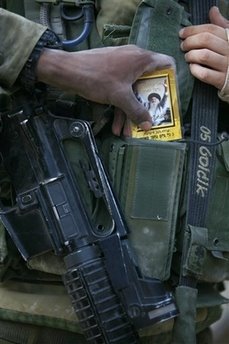
I recently saw this picture on Mentalblog.com of one of our soldiers in Lebanon putting this famous nachman picture and slogan in his pocket in order to protect him.

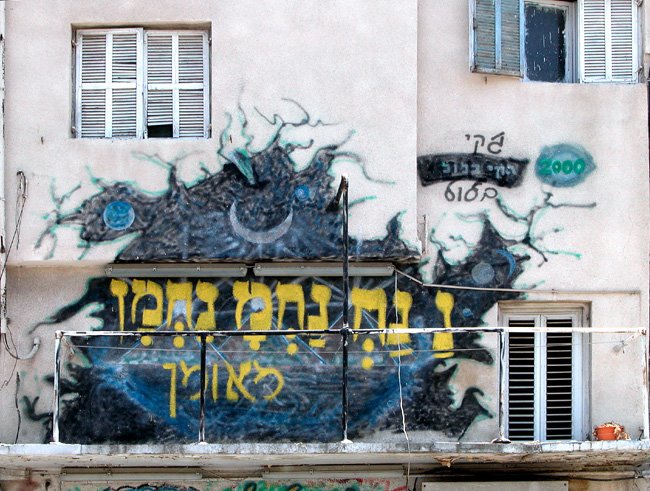
When I was In Israel, I was astounded to see how popular this slogan has become. There is scarcely a billboard, fruit shop, or motorbike where this sticker or graffiti does not appear. I asked a secular man who has one of these pictures in his real estate agency why he chose to put it up? He said some Breslovers came and told him it would be good for business, and with business going the way it is at the moment in Israel, every little bit helps.

Acoording to this source The Na Nach Nachma phrase was revealed and taught by Rabbi Yisroel Ber Odesser, a controversial Breslov figure born in 1905 in Tveria. He was among the first Breslover Hasidim in Israel. When he was only 17 years old, Odesser was overcome with weakness and hunger on the Fast of Tammuz. He decided to eat. But immediately after eating, he felt great sorrow at having succumbed to his own physical temptations. Then a powerful thought came to him: "Go into your room!" He obeyed the inner voice, went to the bookcase, and randomly opened a book. In the book was a piece of paper that would later be known as "The Letter from Heaven." This paper contained a greeting, some text that referred to the Fast of Tammuz, and the Na Nach Nachma mantra.

It read as follows:
It was very hard for me to descend to you, my precious student, to tell you that I benefited greatly from your service. And to you I say, my fire will burn until the coming of the Messiah -- be strong and courageous in your service -- Na Nach Nachma Nachman Me'Uman. And with this I shall tell you a secret: Full and heaped up from line to line, and with strong devotional service you will understand it. And the sign is: They will say you are not fasting on the 17th of Tammuz.Odesser believed the letter to be a message of consolation, directly from Rebbe Nachman's spirit to himself here on earth.

The popularity of this phenomenon is not without controversy. Rabbi Zev Reichmann (head of the Yeshiva University Mechina Program, student of Rav Aaron Soloveitchik, and son of Rav Herschel Reichmann) notes that many within common Orthodox society hold the view that people who wear "Na Nach Nachma" yarmulkes (see below) are not considered to be real Breslovers.

So what’s your view? Have you ever used this phrase or photo to bring you good luck?

Friday, July 21, 2006

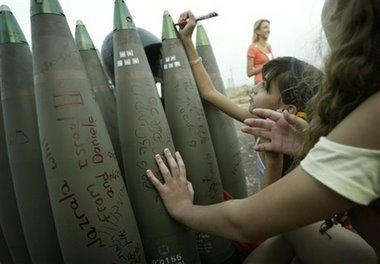
"To Nasrallah with love from Israel and Daniele"


This photo appeared in all the Australian newspapers on Wednesday. I was perplexed. Was it a set up? Who are these girls? What are they writing? Why?

Thanks you to Lisa from “on the face” , I now know what was going on.
The photo was taken by Sebastian Scheiner an Israeli photojournalist who took the photo for Associated Press (AP).
The little girls shown drawing with felt markers on the tank missiles are residents of Kiryat Shmona, which is right on the border with Lebanon. On the day that photo was taken, the girls had emerged from the underground bomb shelters for the first time in five days. A new army unit had just arrived in the town and was preparing to shell the area across the border. The unit attracted the attention of twelve photojournalists - Israeli and foreign. The girls and their families gathered around to check out the big attraction in the small town - foreigners. They were relieved and probably a little giddy at being outside in the fresh air for the first time in days. They were probably happy to talk to people. And they enjoyed the attention of the photographers.

Apparently one or some of the parents wrote messages in Hebrew and English on the tank shells to Nasrallah. "To Nasrallah with love," they wrote to the man whose name was for them a devilish image on television - the man who mockingly told Israelis, via speeches that were broadcast on Al Manar and Israeli television, that Hezbollah was preparing to launch even more missiles at them.

The photograpers gathered around. Twelve of them. Do you know how many that is? It's a lot. And they were all simultaneously leaning in with their long camera lenses, clicking the shutter over and over. The parents handed the markers to the kids and they drew little Israeli flags on the shells. Photographers look for striking images, and what is more striking than pretty, innocent little girls contrasted with the ugliness of war? The camera shutters clicked away, and I guess those kids must have felt like stars, especially since the diversion came after they'd been alternately bored and terrified as they waited out the shelling in their bomb shelters.

Personally, I understand that pacifism never really took off in the middle east and probably never will, but this is ridiculous. Is this one of those "only in Israel" moments that I am proud of? not really. It's bizarre and sad. I said tehillim today with 300 people. Maybe that will help…. Shabbat shalom

Sunday, July 16, 2006

Teaching Israel

Shalom webfreinds,
I’ve recently returned from an invigorating educational sojourn in the Holy land, where I attended a conference with the a keen group of smiling academics and school teachers.

Below are three models we discussed for teaching Israel.

Option Aleph) The Classical Zionist Approach
The ‘evil goyim’ tried to kill us throughout our history, from Shushan to Chmielnitski and Kishinev (they were cities before they were pogroms). They killed us in the present generation, Shoah, because the diaspora is doomed (France, Argentina), therefore Aliyah for all is the only answer. Our role models should be those who die for the homeland like Trumpeldor, Eli Cohen, Yoni Netanyahu.
Proponents: Theodore Herzl, Tuvia Book, The Palmach Museum

Option Beit) The Religious Zionist Approach
The first Olim were not the Hovevi Tziyon in 1882, but Avraham Avinu who was on the first nefesh be nefesh trip from Ur Kasdim to Cannan in 1700BCE. Since then, all Jews have wanted to return, but didn’t ’cause they were waiting for mashiach. These folks decided its time to stop waiting. Israel is “reshit tzmichat geualteinu,” If only we can occupy the entire biblical moledet.

The religious Zionists (orange camp) were very upset with Gaza disengagement last year. We watched a video that made us cry. It showed the pain of the 0.5% of Jews who had to leave their villas and featured not a single one of the 99.5% of the Palestinians who suffered under this occupation for 39 years.
Proponents: No hard-core representatives of this group addressed us.

Option Gimmel) The Peoplehood (yes, it is a real word despite my spellchecker thinking otherwise) Approach
Jews live all over the world and we each have amazing stories to tell that we can learn from. Students should feel they are Jewish citizens of earth, rather than exiled spectators to the main event, which is Israel. The centre of the Jewish world has moved from Cannan, to Babylon, Cordoba, Mainz, Kairwan(Tunis) and now to Israel. It will keep moving as Jews keep moving. Our role as educators is to have students “connecting with community.”
Proponents: Steve Israel, Dena Thaller
Some say that the Centre for Teaching of Jewish Peoplehood at TA University, may be the Yad Vashem of the next generation.

My thoughts

Each model has it’s own strengths and weaknesses. But as was said many times, “the medium is the message,” which means HOW you teach Israel is just as important as WHAT you teach.

Finally, there are so many sweet tidbits of goodness going on in Israel that few people are aware of, like the Sapir Academic College in Sderot that provides an education and a better future to the olim from places like Chechniya. Like Rabbi Motti-Bar Or, whose amazing organization Kolot changes the perception of Limmud Torah being only for the datiyim, and returns, as God did at Mt Sinai, the ownership of our scared texts to the entire Jewish people (females and secular included). Like the thousands who watched the World Cup final on a warm Tel-Aviv Beach and cheered for Italy because they are LESS anti-Semitic.
Like the Ma'ale School of Television, Film and the Arts, which is providing an avenue for the young religious to raise questions that have been condemned by an earlier generation.
Like Dr Tova Hartman, who is challenging the models of negative identity by which we have so long perceived ourselves, like Rav Binyamin Lau, who has moved from Hitnatkut (Disengagement) to Hitchabrut (Connection) in reaching out to the Jews of greater Judea and Samaria. And finally, like Robbie Gringlas, who "shlectures” about us having a mature relationship with 58 year old Israel, warts and all, that can be filled with anger, tears, laughter and song. Shkoyach to you all!

Monday, May 29, 2006

Olmert needs some PR advice

Shmuel Rosners’s blog on Haaretz discusses Olmert’s use of language on his recent US trip.
Olmert chose the term "realignment" as the official translation to the name of his plan. "I think it means 'hitkansut' (the Hebrew word for the plan)," he told us during the visit when asked about the choice of words. "Sometimes," Olmert said, "the same word in Hebrew has several meanings in English, and I heard of a few, and of them the term that seemed to me most representative is 'realignment,' to the best of my knowledge of English."

After discussing the matter with many knowledgeable Americans, we concluded in our article it was a foolish choice. "Realignment," said a senior American reporter, "is something that you do to your car tires" rather than a catchy name of a daring political plan.

There was consensus among Olmert's American listeners with which we met: "Consolidation" is a much more appropriate word for those who are afraid to use the clear term: "withdrawal". But some other suggestions were made, and we figured time for action is now (as Olmert told Bush about Iran).

So, I ask you dear readers of “I wonder If,” put your marketing degrees to use, think like the spin makers and PR consultants, and share how you think Ehud Olmert should be labeling his plan to remove what may be up to 70 000 Jews from their homes in Judea and Samaria in order to create a Palestinian state more or less along the lines of what Barak offered at Camp David(See map, whereby no Jews would be living in grey shaded areas by 2008).

I have included a few suggestions from Rosner below:
* Realignment
* Withdrawal
* Consolidation
* Convergence
* Disengagement 2
* Reversion("act of turning something the opposite way; act of returning to a previous condition; return of property to its owner after the occurrence of a particular event")
* Olmert`s Folly
* Second Stage of Israel`s Suicide
* Honey I Shrunk Israel Plan
* We will not give in to Terror Plan
* Intifada,Outerfada?
* Hexodus
* Redeployment and fortification
* Project return
- Surrender-to-Arab-Terrorism Plan
- National Retreat Plan
- National Defeat Plan
* Detachment
* Contraction (although it makes me think of being in labour -not the Amir Peretz kind)
* Resettlement
* Strategic unilateral retreat
* Operation justice prevails
* Victory of Hamas
* Yasser’s Revenge
* Green light to the green line