Monday, May 22, 2006

A light unto the nations?

The Jewish State was built on the back of Yishayahu’s prophetic notion that we should be a "a light unto the nations"(Isaiah 42:6; 49:6).

So then what does our state do when people arrive in need? The government of Israel, the worlds only Jewish government, puts them in prison because they don’t have valid visas. Of all the wonderful examples Israel could learn from Australia, our successful migration intake, our welfare and education systems, why did Israel choose to copy our system of mandatory detention? This story from Haaretz today: Yad Vashem chairman urges PM to let Darfur refugees stay in Israel
The chairman of the Yad Vashem Holocaust Martyrs' and Heroes' Remembrance Authority, Avner Shalev, called Sunday on Prime Minister Ehud Olmert to allow refugees from the war-torn Darfur region of Sudan to remain Israel.
In a letter to Olmert, Shalev wrote that, "as members of the Jewish people, for whom the memory of the Holocaust burns, we cannot stand by as the refugees from the genocide in Darfur hammer on our doors. The memories of the past and Jewish values compel us to show solidarity with the persecuted."

Shalev pointed out that during the Holocaust, countries such as Australia, Canada and Britain cited security reasons when they sent Jews escaping the Nazis to detention camps.

In early May, Holocaust researcher Professor Yehuda Bauer, an academic advisor to Yad Vashem, added his name to a High Court petition brought by the Hotline for Migrant Workers against the Israel Defense Forces Head of Operations Directorate, Brigadier General Gadi Eisencott, who signed an order to expel 31 Sudanese refugees from the Darfur region without giving them the right to make their case. See here also.

This is an embarrassment. We can surely do better than this!

Monday, May 08, 2006

How humane is shechita of cows?

The Torah requires that meat and poultry be slaughtered in a prescribed manner known as shechita. The trachea and esophagus of the animal are severed with a special razor-sharp, perfectly smooth blade, causing instantaneous death with no pain to the animal.” (oukosher.org)

But is this always the case? In the course of the probe of AgriProcessors Inc. of Postville, Iowa, by the Inspector General of the U.S. Department of Agriculture in late 2004 it was found that employees of one of the nation's major kosher slaughterhouses "had engaged in acts of inhumane slaughter," [and] that federal inspectors did nothing to stop it and instead accepted gifts of meat from plant employees. The plant is the America's largest producer of meat certified as glatt kosher.

To see a video of this slaughter click here

For those that don’t have the stomach to watch this video, it shows "electric prods used to shock the faces of cows in order to guide them into the slaughter pen. The pictures also showed an uncommon practice of speeding post-shehita blood flow by using large hooks to rip out the animals' trachea (windpipe) and esophagus (food pipe) while the animals are still conscious. Immediately after the procedure cows are seen standing and attempting to bellow and leave the killing-floor area.

It is important to note that the ideal kosher cut would sever the trachea, esophagus and carotid artery, thus immediately eliminating blood flow to the brain and rendering an animal unconscious in as quickly as 10 seconds. Contrary to widespread perceptions, however, a valid kosher slaughter requires only the cut of the trachea and esophagus. The post-cut scenes on the videos of staggering, mutilated animals seem to be cases in which the carotid arteries were not severed, thus leaving the animal conscious and able to suffer pain. Source:jpost
Reacting to these published findings, the head of the Israeli Chief Rabbinate's international ritual slaughter division, Rabbi Ezra Raful, said that he would permit the import of meat to Israel from the slaughterhouse in question, saying that "in the case of AgriProcessors, there is no halachic problem."

Thankfully, many poskim, including Maimonides, believe that the prohibition against cruelty to animals informs our interactions with animals far beyond sadism.

Rabbi Ezra Raful also said Jewish law permitted a non-Jew to use a hook to sever an animal's carotid arteries, as long as most of the trachea and esophagus were severed by the shochet [ritual slaughterer].

He said that if a Jew used the hook, the slaughter was not kosher because of the halachic principle of marit ayin - the mistaken impression that the ripping of the arteries with a hook was part of the Jewish slaughtering process. This issue would not arise if a non-Jew ripped out the artery, since a non-Jew is disqualified from performing shehita (ritual slaughter).

Raful said he had been informed by sources in AgriProcessors that only non-Jews performed the ripping. Raful said it was unfair to apply subjective criteria of cruelty to shehita.

"For me it is terribly cruel to boil a lobster live or to fry a live shrimp or freeze a fish live. It depends on what you are used to. It's all very subjective. "But the Torah is not subjective and the same Torah that prohibits cruelty to animals allows shehita," he said.… (Click here for full article)

So, what are our options now? As a meat eater, I believe one should do the following.

1. Watch the video of the shechita, If you are OK with what happens there, keeping eating meat with no worries.
2. If the video bothers you. Stop eating beef and write letters to the kashrut authorities demanding that the laws of the shechita be followed not just to the letter of the law, but also in the spirit of the law as Rambam prescribes.
3. Stop eating meat altogether

From a reliable source I have found out that in Australia animals are not slaughtered in the same manner as the Iowa plant and thus actually may suffer less than non-kosher animal slaughter. In Australia, the shackle and hoist method(used in Israel) where the cow is strung up by its legs before shechita is not used. Also, the animal is shot with a blot immediately post shechita.

Does any of this effect what you will be eating for dinner tonight?

Wednesday, March 29, 2006

Israeli youth show respect for elders

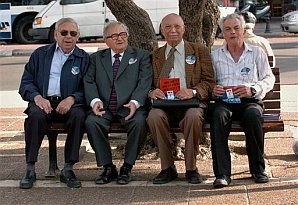
For those of you cruising blogland as we speak, you will find pages of analysis regarding the lower voter turnout, Labour and Israel Beitenu’s surprisingly good result, and Likud and Kadima’s lower than expected vote. In my humble opinion, the winning party of this election is Gil, the pensioners party, winning 8 seats according to exit polls. To the right is a photo of Gil pensioners' party leaders Yitzhak Ziv, Yaacov Ben-Izri, Rafi Eitan and Moshe Sharon, sitting on bench in Tel Aviv on Monday.

Jpost reports:
Tel Aviv buzzed with rumors on Tuesday that the Gil pensioners' party passed the vote threshold needed to enter the 17th Knesset. In the stage built by Channel 10 in the center of Rabin Square in the city's center, hundreds gathered to look at the parties' stalls. The general consensus seemed to be that "Tel Aviv was voting for the pensioners."
In front of one Tel Aviv polling booth, four well-dressed trendy-looking 20-somethings tried to convince passers-by to vote for the pensioners' party. Though the activists seemed uncertain of where the party stood on issues such as defense and the economy, they said that as young, well-off Tel Aviv residents, they wanted to do something to help the "poor old people." They also acknowledge that it was a trend among youth in Tel Aviv to vote for the Gil party.
One Gil supporter, Sonya Blikin, saying she was "voting for the pensioners because they're the only party with a platform I can support. Actually, I'm not sure what the platform is," she admitted, "but I know that old people and poor people are sitting in the streets, and I feel bad and I want to do something to help them."
And how about these kids at Rabin Square who instead of voting for the green leaf party, voted to help sabba and savta:
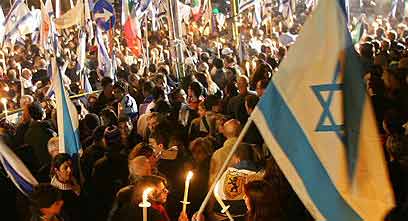
Back at Rabin Square, a crowd of teenage girls chanted "Save our grandfathers" on Tuesday afternoon. They said they had no official affiliation with any party, but had decided to come to the square at the last moment because "the old people need all the help they can get."

The election of Gil shows once again that Israeli youth are an or lagoyim. See also Haaretz for more on Gil’s very vauge security platform.

Saturday, March 25, 2006

Too much of a good thing?

Is it possible that us diaspora fans of Zion are loving Israel too much. Daniel Levy writes in Haaretz about the new John Mearsheimer and Stephen Walt study of "The Israel Lobby and U.S. Foreign Policy." He says:

It should serve as a wake-up call, on both sides of the ocean. The bottom line might read as follows: that defending the occupation has done to the American pro-Israel community what living as an occupier has done to Israel - muddied both its moral compass and its rational self-interest compass.

Interesting food for thought. Has our love of Israel blinded us to Isiah’s vision expressed in the Jerusalem program of building a nation based on the prophetic vision of righteousness and peace(justice).

Friday, February 24, 2006

Aviezer Ravitsky in Melbourne

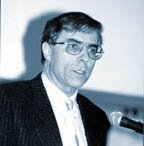
Over the past week, I have had the pleasure of hearing Professor Aviezer Ravitsky speak in Melbourne on a number of occasions. He was the winner of the 2001 Israel Prize, and I found many of his statements on matters religious and political to be similar to my thinking. I believe Ravitsky is unique in that he is able to transverse the worlds of academia and halacha so seamlessly, in a matter that belittles neither. He is also a religious Zionist that doesn’t wear orange.
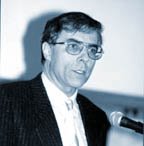
One the issues he spoke about was his recent paper “Is a Halakhic State Possible? The paradox of Jewish Theocracy” (Published by the Israel Democracy Institute).

To many Religious Zionists (henceforth RZ’s) namely of those from the Mercaz Harav-Kook Yeshiva, their justification for supporting the Zionist enterprise rests solely on the idea that Israel is the birth pang of mashiach – reshit tzemichat geulatenu. RZ ideal Israel is one run by halacha, were Jewish law governs the social, religious and political spheres.

Avi sees things differently. I quote from Haaretz Temple and Knesset
Ravitsky believes (to a great extent following in the footsteps of Rabbi Yitzhak Abarbanel, 1437-1508) that Judaism contains no absolute religious commandment that determines the nature of the regime required by the Jewish state. The state's authority is needed to protect citizens' lives and to maintain the social order, and precisely in order to serve those goals, there must be broad social agreement - the essential idea being that the preservation of human life takes precedence over nearly all the Torah's commandments.

Ravitzky quotes the late Rabbi Shlomo Goren: "Human society, including the Jewish people, requires a political regime representing and applying relative justice, namely, temporary political justice, which enables the regime to maintain public order and security among mortals. One cannot rely only on the Torah's law of punishment, which represent the absolute justice, not influenced by the constraints of time, place and the level of human society.

Some examples Ravitsky gave regarding the quirks of halacha were fascinating. What would you do if you saw a man chase a woman into a cave with a sword, and then heard screaming, only to find the woman killed. Well, in a halachic state, the man could not be charged, for unless two shabbat and kashrut keeping witnesses saw the murder take place, and forewarned the culprit, he escapes punishment.

Also, the laws regarding theft are not nearly serious enough to deter the crime in today's world whilst the halachic tax system of the Government returning double of it receives would lead to a tax free world for 1 in 3 people. (I can see Kerry Packer, our most renowned tax dodger, lamenting his lack of support for a halachic state now.)

In regards to the possibility of harmony between Religious and Secular Israelis, Ravitsky spoke at length about the contention between these groups at a public lecture sponsored by the Australian Centre for the Study of Jewish Civilisation at Monash University.

He spoke about the infamous “Status quo” which was written in a letter from David Ben Gurion, in his capacity as Chairman of the Jewish Agency Executive, to Rabbi J. L. Maimon, leader of the Agudat Israel in 1947. The letter stated
· Shabbat: It is clear that the official day of rest of the Jewish State will be on Shabbat; naturally the Christians and other religions will be granted the Shabbat on their days.
· Kashrut: All necessary steps will be taken to guarantee that any State kitchen for Jews will be kosher.
· Personal Status Law: The members of the Executive understand the importance of the question and the problems involved. All the bodies which are represented on the Executive will do all to satisfy the religious needs of the Orthodox, to prevent the division of the people.
· Education: The autonomy to the different educational systems (as now exists) will be guaranteed. No coercion from the authorities in matters of religion, and religious conscience will be applied. Naturally, the State will determine minimum studies in Hebrew, mathematics, history, etc., and will supervise them, but they will have the freedom to run the educational system according to their belief.

Ravistky discussed why both the Haredim and Socialist Zionists agreered to this document. In 1947, the Secular Zionists didn’t think there would be Haredim in 50 years, let alone ones who would want to study in yeshiva. Therefore, it was of little concern to Ben Gurion that a few hundred Haredim didn’t serve in the Army. The Haredim on the other hand, didn’t mind a few cars driving on Shabbat, as long as no public transport was running(still the case now in Israel except Haifa). What the Haredim didn’t anticipate, was that one-day cars would become very popular.

Both assumed the other would disappear, and both made their assumptions on false premises. So what hope is there for future harmony between these groups. Well, having already, argued that a halachic state is not feasible, one could say, what about a secular state? Ravitsky also rejects this idea arguing

Not only it is impossible, from the standpoint of Judaism, to contemplate a modern Jewish life unconnected with tradition, from the standpoint of the State of Israel itself, the desire to return to the Jewish-national past - at all strata and levels - can have no validity if this return is characterized by severing ties with the religious infrastructure, which is the basis of all the national and historical aspects of Jewish existence.

So perhaps our future is to continue on the path we are on. Namely, where the Godfearing and Godless stay at each others throats. This “tension” afterall is what keeps Ravitsky in his job. He loves it. The “tension” is also what keeps this blog going. Forever searching for answers to seemingly unsolvable questions.

Saturday, February 11, 2006

Amona violence: The result of occupation on Israel

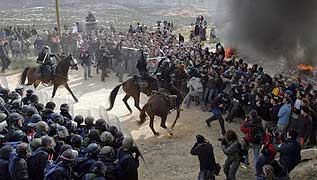
In the past week, hundreds of protesters were injured by police during a protest at the Amona setllement were 9 homes were evacuated. The resulting violence is now the subject of a Knesset inquiry. Rabbi Micahel Melchior of the Meimad Party had this
to say of the incident in Haaretz.

The stones that were thrown by skullcap-wearing youths from the rooftops of Amona, and the rolling of eyes heavenward ?(and also at the Israeli public?) that followed, injured not only the head of the policeman who was rushed to the hospital in critical condition, but also, to the same extent, the heart of Judaism, the Torah itself.

The police's special patrol unit is the same special patrol unit; the minions, the hilltop youth, are the same minions. Only religious Zionism is not what it once was. From a glorious movement, a symbol and model of Jewish renewal in our times, it has become an extremist movement, irrelevant to the Judaism of the majority of Israeli society. The knitted skullcap has given way to ski masks, and the hoe and the tablets of the Ten Commandments − the symbol of the Bnei Akiva youth movement − to cinder blocks and stones.

It used to be different. From the days of rabbis Isaac Jacob Reines and Judah Leib Maimon to the government ministers Haim-Moshe Shapira and Zerach Wahrhaftig, religious Zionism presented an entirely different face. Its teachers and leaders preached compromise, peace, finding a common denominator. Out of a deeply rooted and burning Torah belief, they clung to the value of sensitivity to the suffering of the "other."

Like tens of thousands of other people, I grew up in the lap of religious Zionism. Because of it, I immigrated to Israel and I educated my children in accordance with its philosophy. In the Bnei Akiva movement they educated us to love of the land, to commitment to and solidarity with the Jewish people, and to adherence to the values of the Torah. This was an equilateral triangle, the power of which was in the combination of all of its elements, and especially the maintenance of the balance among them.

In the mid-1970s the process of sliding down the slippery slope began. Fanaticism, extremism and insensitivity to the "other" replaced the old values. The delicate fabric of religious Zionism unraveled. The Jewish people and the Torah were sidelined and their place was taken by the land of Israel. Not the land "of milk and honey" of the prophets? vision, full of justice and equality, but rather a fundamentalist, xenophobic land of Israel. A land of bullying and violence, of injured policemen and uprooted olive trees.

The violent event at Amona hammered another nail into the coffin of religious Zionism and made the Torah a synonym for bullying, extremism and hatred of the "other." In the minds of the settlers there are the rights of humans, and then there are the rights of "our people." The events at Amona have taught us that uncompromising violence and the flying batons of the police know no bounds and do not discriminate between Jew and Arab. All are the same, and smashing the head of an Arab leads easily to smashing the head of a Jew.

These words remind me of the late Yeshayahu Leibowitz, a philospher and professor of biochemistry at Hebrew University who famously predicted in early 1968 that Israel's occupation of Arab lands seized in the Six-Day War would be a curse on the country. The effect of occuption on the isreali psyche is one that allows and even perpetuates the use of violence to achive an ends. So why the surprise when that violence is direteed against our own? Melchior continues
Similarly, there is no such thing as halfway democracy. An entire generation of religious Zionism has been raised on the idea that if between the Jordan River and the Mediterranean there are 4.7 million Palestinians, it isn't terrible if they remain without rights, and if their 6- and 7-year-old children have to be accompanied by Israel Defense Forces soldiers on their way to school for fear of the wrath of masked Jews. Then so be it. They should say thank you and shut up. It is no wonder, then, that when democracy was exalted by the settlers during the period of the disengagement, nobody believed them.

Vox populi vox dei. Between the special patrol battalions and the battalions of the minions this week, the Torah and the philosophy of religious Zionism stood off in a corner, grieving and in disgrace, scorned, mortified and ashamed. In a single day, they had become identified with people in masks hurling rotten eggs at IDF soldiers and large stones, lobbed at the police of the state "of the beginning of our redemption."

No less appalling is the terrible silence of the leaders and teachers. As the years go by, in the name of Torah, fundamentalist voices that our fathers never imagined are being disseminated. Indeed, the wrath of the minions has fallen upon the leaders of the flock, who disappeared, their voices stilled. The redemptive genie has been released from its bottle and has started to destroy everything good in religious Zionism.

As a result of these distortions, most of the people living in Israel are no longer aware of the wonderful, gracious deeds of religious Zionist society here and now, the pioneering spirit that continues to throb within it, its rallying to absorb immigration or the splendid educational institutions it has established.

The difficult scenes at Amona have caused unimaginable damage both to religious Zionism and to the State of Israel. Their effects are influencing the solidarity of Israeli society, the country's image in the eyes of the world and the eyes of world Judaism, and its ability to stand strong in the face of the challenges that still await it.

It is a debate about which direction we are heading, but we must not compromise for a single moment about the methods we use to get there.

For a generation now we have been fighting for the justice of our existence. Facing us are belligerent neighbors who wish to destroy us and fundamentalist states that possess weapons of mass destruction. In this state of affairs Israel must choose another way. One way. Not the way of apartheid, but rather the way of the Jewish and democratic state.
Indeed, this way necessitates painful compromise. Compromise that does not concede the idea of the land of Israel or the idea of redemption. Not disgust, heaven forbid, with respect to the beloved land, but rather the opposite − adherence to it, inside borders dividing us and the Palestinian state, without which we will not be a Jewish state, from a desire to have in it a society that will be a light unto the nations. A society of justice and peace, for every human because he is human.

We need more rabbis that speak like this. We need more people to use Torah for peaceful purposes… Letakken Olam BaMalchut Shaddai.